• Link to X
  • Link to Facebook
  • Link to Instagram
  • Link to LinkedIn
  • Link to Youtube
  • Donate to fight Lafora disease!
  • Contact Us
info@chelseashope.org
Chelsea's Hope Lafora Children Research Fund
  • What is Lafora Disease?
    • About Lafora Disease
    • ICD-10 Codes for Lafora Disease
    • Lafora Disease Symptom Checker
    • Lafora Disease Therapy
    • Lafora Disease Clinical Pipeline Progress
    • ION283 Safety Study
    • Family Stories
  • About Us
    • Chelsea’s Story
    • Leadership Team
    • Advisory Board
    • Contact
  • News
  • Resources
    • For Families & Caregivers
      • Newly Diagnosed
      • Tips for Lafora Disease Families
      • Bereavement Support
      • G-Tube Tips – A Mother’s Perspective
      • Lafora Clinical Network Registry
      • Refer Your Clinician to the Registry
    • For Researchers
      • Lafora Mutations Database
      • Lafora Canine Registry and Database
      • Apply to Join the Clinical Registry
  • Events
    • 2026 Lafora Science Symposium
    • Courage in Care: Lafora Caregiver Series
    • Lafora Disease Roundtables
  • Get Involved
    • Ways to Give
    • Volunteer
    • Join Canine Registry
  • Click to open the search input field Click to open the search input field Search
  • Menu Menu

Tag Archive for: seizures

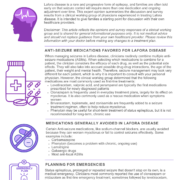
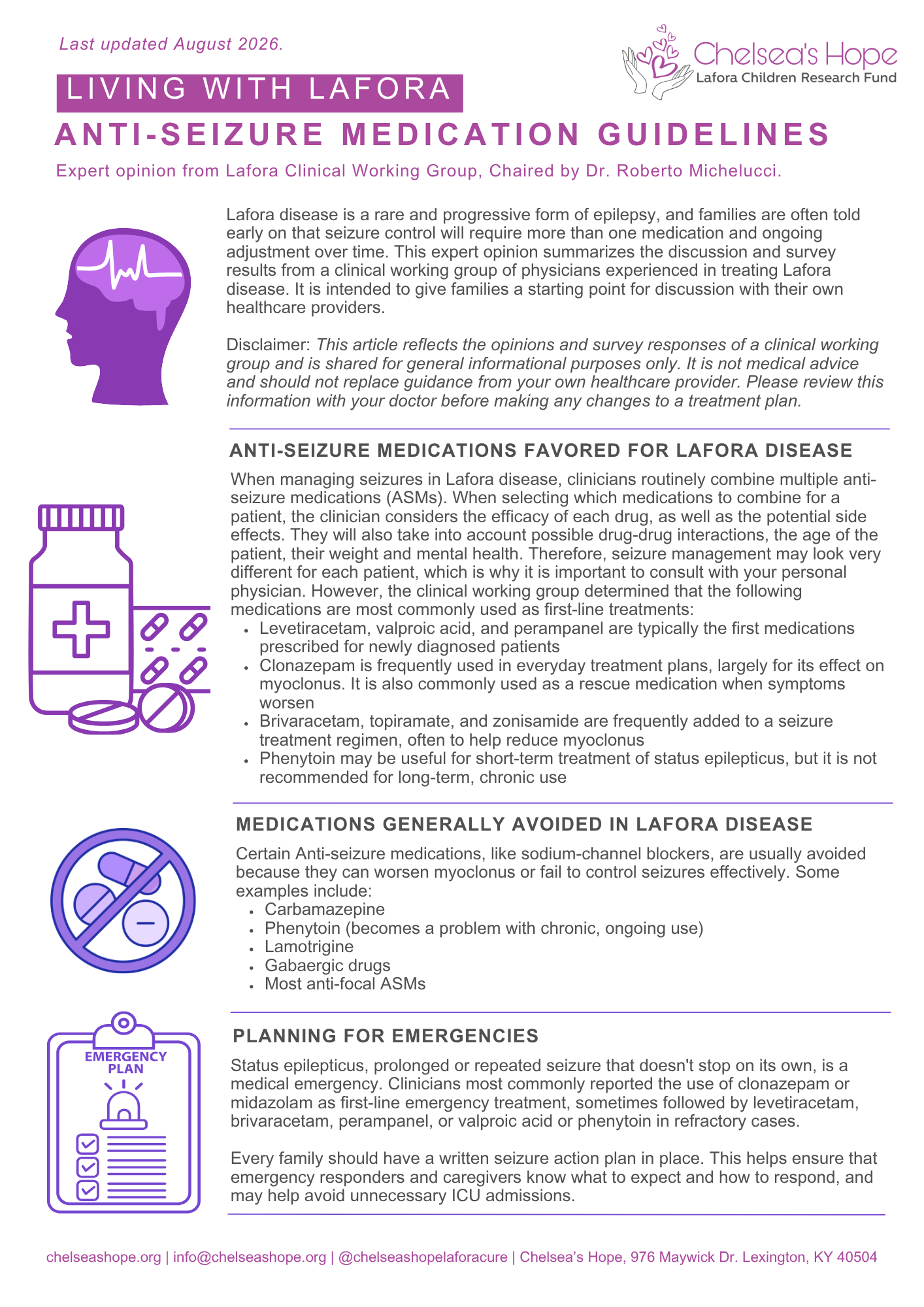
Last updated August 2026. L I V I N G W I T H L A F O R A A N T I - S E I Z U R E M E D I C A T I O N G U I D E L I N E S Expert opinion from Lafora Clinical Working Group, Chaired by Dr. Roberto Michelucci. Lafora disease is a rare and progressive form of epilepsy, and families are often told early on that seizure control will require more than one medication and ongoing adjustment over time. This expert opinion summarizes the discussion and survey results from a clinical working group of physicians experienced in treating Lafora disease. It is intended to give families a starting point for discussion with their own healthcare providers. Disclaimer: This article reflects the opinions and survey responses of a clinical working group and is shared for general informational purposes only. It is not medical advice and should not replace guidance from your own healthcare provider. Please review this information with your doctor before making any changes to a treatment plan. ANTI-SEIZURE MEDICATIONS FAVORED FOR LAFORA DISEASE When managing seizures in Lafora disease, clinicians routinely combine multiple anti- seizure medications (ASMs). When selecting which medications to combine for a patient, the clinician considers the efficacy of each drug, as well as the potential side effects. They will also take into account possible drug-drug interactions, the age of the patient, their weight and mental health. Therefore, seizure management may look very different for each patient, which is why it is important to consult with your personal physician. However, the clinical working group determined that the following medications are most commonly used as first-line treatments: Levetiracetam, valproic acid, and perampanel are typically the first medications prescribed for newly diagnosed patients Clonazepam is frequently used in everyday treatment plans, largely for its effect on myoclonus. It is also commonly used as a rescue medication when symptoms worsen Brivaracetam, topiramate, and zonisamide are frequently added to a seizure treatment regimen, often to help reduce myoclonus Phenytoin may be useful for short-term treatment of status epilepticus, but it is not recommended for long-term, chronic use MEDICATIONS GENERALLY AVOIDED IN LAFORA DISEASE Certain Anti-seizure medications, like sodium-channel blockers, are usually avoided because they can worsen myoclonus or fail to control seizures effectively. Some examples include: Carbamazepine Phenytoin (becomes a problem with chronic, ongoing use) Lamotrigine Gabaergic drugs Most anti-focal ASMs PLANNING FOR EMERGENCIES Status epilepticus, prolonged or repeated seizure that doesn't stop on its own, is a medical emergency. Clinicians most commonly reported the use of clonazepam or midazolam as first-line emergency treatment, sometimes followed by levetiracetam, brivaracetam, perampanel, or valproic acid or phenytoin in refractory cases. Every family should have a written seizure action plan in place. This helps ensure that emergency responders and caregivers know what to expect and how to respond, and may help avoid unnecessary ICU admissions. chelseashope.org | info@chelseashope.org | @chelseashopelaforacure | Chelsea’s Hope, 976 Maywick Dr. Lexington, KY 40504Chelsea's Hope Lafora Children Research Fund

New Resource: Lafora Anti-Seizure Medication Guidelines

August 28, 2026/by Chelsea's Hope

Last updated August 2026. L I V I N G W I T H L A F O R A A N T I - S E I Z U R E M E D I C A T I O N G U I D E L I N E S Expert opinion from Lafora Clinical Working Group, Chaired by Dr. Roberto Michelucci. Lafora disease is a rare and progressive form of epilepsy, and families are often told early on that seizure control will require more than one medication and ongoing adjustment over time. This expert opinion summarizes the discussion and survey results from a clinical working group of physicians experienced in treating Lafora disease. It is intended to give families a starting point for discussion with their own healthcare providers. Disclaimer: This article reflects the opinions and survey responses of a clinical working group and is shared for general informational purposes only. It is not medical advice and should not replace guidance from your own healthcare provider. Please review this information with your doctor before making any changes to a treatment plan. ANTI-SEIZURE MEDICATIONS FAVORED FOR LAFORA DISEASE When managing seizures in Lafora disease, clinicians routinely combine multiple anti- seizure medications (ASMs). When selecting which medications to combine for a patient, the clinician considers the efficacy of each drug, as well as the potential side effects. They will also take into account possible drug-drug interactions, the age of the patient, their weight and mental health. Therefore, seizure management may look very different for each patient, which is why it is important to consult with your personal physician. However, the clinical working group determined that the following medications are most commonly used as first-line treatments: Levetiracetam, valproic acid, and perampanel are typically the first medications prescribed for newly diagnosed patients Clonazepam is frequently used in everyday treatment plans, largely for its effect on myoclonus. It is also commonly used as a rescue medication when symptoms worsen Brivaracetam, topiramate, and zonisamide are frequently added to a seizure treatment regimen, often to help reduce myoclonus Phenytoin may be useful for short-term treatment of status epilepticus, but it is not recommended for long-term, chronic use MEDICATIONS GENERALLY AVOIDED IN LAFORA DISEASE Certain Anti-seizure medications, like sodium-channel blockers, are usually avoided because they can worsen myoclonus or fail to control seizures effectively. Some examples include: Carbamazepine Phenytoin (becomes a problem with chronic, ongoing use) Lamotrigine Gabaergic drugs Most anti-focal ASMs PLANNING FOR EMERGENCIES Status epilepticus, prolonged or repeated seizure that doesn't stop on its own, is a medical emergency. Clinicians most commonly reported the use of clonazepam or midazolam as first-line emergency treatment, sometimes followed by levetiracetam, brivaracetam, perampanel, or valproic acid or phenytoin in refractory cases. Every family should have a written seizure action plan in place. This helps ensure that emergency responders and caregivers know what to expect and how to respond, and may help avoid unnecessary ICU admissions. chelseashope.org | info@chelseashope.org | @chelseashopelaforacure | Chelsea’s Hope, 976 Maywick Dr. Lexington, KY 40504We have a new resource for families developed by some members of our Lafora Clinical Network: Anti-Seizure Medication Guidelines. This document provides information to help Lafora families discuss seizure management with their clinicians.

Special thanks to the clinical working group led by Dr. Roberto Michelucci, who put together these guidelines. You can now download the document to your device, or print a copy to reference. Please check back for updates.

View Guidelines Right-open Right-open

Guidelines created in August 2026.


https://chelseashope.org/wp-content/uploads/2026/08/Anti-Seizure-Medication-Guidelines-.png 2000 1414 Chelsea's Hope https://chelseashope.org/wp-content/uploads/2022/02/ChelseasHope1.png Chelsea's Hope2026-08-28 12:11:132026-08-28 12:12:03New Resource: Lafora Anti-Seizure Medication Guidelines

Chelsea’s Hope supports Purple Day 2024

March 26, 2024/by Christine Kelly

Purple Day - March 26 www.purpleday.orgIn unity with worldwide epilepsy advocates, Chelsea’s Hope has pledged its support for World Purple Day 2024. Epilepsy advocate Cassidy Megan founded the international initiative to raise awareness about epilepsy. Today, on March 26, people wear purple to show solidarity with those affected and support advocacy efforts. 

Approximately 50 million people live with epilepsy globally, including Lafora Disease warriors. An extremely rare epilepsy, Lafora is complex and has limited treatment options. Symptoms of the disease, also known as Lafora progressive myoclonus epilepsy, include increasingly recurrent, intractable seizures and myoclonus. 

Chelsea’s Hope remains committed to improving the lives of those affected by Lafora Disease. Accordingly, the organization has shared social media advocacy tools to raise awareness about the unique challenges of Lafora, as well as links to other organizations and support that families could benefit from on our Resources page. 

If you join in sharing on social media, then here are some caption ideas: 

💁‍♀️ Share about who you wear purple for.

💬 Explain some facts, like how Lafora Disease is often misdiagnosed as Juvenile Myoclonic Epilepsy.

🧠 Describe symptoms of Lafora, like recurrent seizures.

Purple Day is an opportunity for education and empathy for all affected by epilepsy, including Lafora patients and their loved ones. Together, we can work towards a future where epilepsy is better understood and all individuals receive the support and care they deserve. Together, we fight Lafora.

https://chelseashope.org/wp-content/uploads/2024/03/Purple-Day-2024-Featured-Image.png 628 1200 Christine Kelly https://chelseashope.org/wp-content/uploads/2022/02/ChelseasHope1.png Christine Kelly2024-03-26 08:10:312024-03-26 08:10:31Chelsea’s Hope supports Purple Day 2024
This image has a purple background photo of a purple stethoscope and purple ribbon. White text says 'We support' then purple text on a semi-transparent white background says '#EpilepsyDay.' Below, white text says '12 February, 2024.' The Epilepsy Day logo on a white circle is beneath all the text. The white Chelsea's Hope Lafora Children Research Fund logo is in the bottom right hand corner.
Epilepsy Day and SAP 2024

February 12, 2024/by Christine Kelly

Chelsea’s Hope Supports Epilepsy Day and Seizure Action Plan Awareness Week 2024

This image has a purple background photo of a purple stethoscope and purple ribbon. White text says 'We support' then purple text on a semi-transparent white background says '#EpilepsyDay.' Below, white text says '12 February, 2024.' The Epilepsy Day logo on a white circle is beneath all the text. The white Chelsea's Hope Lafora Children Research Fund logo is in the bottom right hand corner. Chelsea’s Hope proudly supported Epilepsy Day on Monday, February 12, 2024.

This International Epilepsy Day, we joined in raising awareness on social media, including sharing facts about Lafora progressive myoclonus epilepsy. For example…

Did you know? 

  • Seizures in adolescence are one of the first symptoms of Lafora Disease.
  • Lafora Disease is commonly misdiagnosed as Juvenile Myoclonic Epilepsy.
  • Lafora Disease symptoms include recurrent, increasingly intractable seizures.
  • Lafora Disease symptoms include muscle jerks and spasms, also called myoclonus.

We educated new audiences across platforms about Lafora Disease and will continue to do so beyond Epilepsy Day. Chelsea’s Hope believes raising awareness about Lafora will lead to better funding, support, and opportunities for all those affected by the rare epilepsy. We invite you to join and have resources available to help your advocacy efforts. 

Chelsea’s Hope also signed the Epilepsy Action Network letter to President Biden, requesting increased federal investment for epilepsy research.

Seizure Action Plan Awareness Week 2024

SEIZURE ACTION PLAN AWARENESS WEEK February 12-19, 2024. The SAP SEIZURE ACTION PLAN COALITION logo is in the bottom center of the image. #SAPAW2024 SeizureActionPlans.org

Epilepsy Day has kicked off seizure action plan (SAP) awareness week, February 12-19, 2024! Since Lafora symptoms include seizures, having a plan in place with tailored guidelines on how others can respond could create comfort and reduce complications in an emergency situation.

Educate and empower your family and friends to respond if your loved one has a seizure. It’s never too late to develop a SAP with your Lafora patient’s care team and healthcare provider! Visit https://seizureactionplans.org/ to get started. You can also join the SAP coalition in raising awareness through social media!

https://chelseashope.org/wp-content/uploads/2024/02/Epilepsy-Day-2024-LinkedIn.png 1200 1200 Christine Kelly https://chelseashope.org/wp-content/uploads/2022/02/ChelseasHope1.png Christine Kelly2024-02-12 18:54:212024-02-27 11:25:55Epilepsy Day and SAP 2024

About Chelsea’s Hope

Chelsea’s Hope began as a website in the fall of 2007 to share Chelsea Gerber’s story with family and friends. A 501(c)(3) organization since 2009, we have made an impact by raising awareness, connecting families worldwide, funding research, and maintaining hope.

Our mission is to improve the lives of those affected by Lafora disease and help accelerate the development of treatments. [Read More]

View Chelsea’s Hope Newsletter Archive 

Donate to Lafora Research

Latest News

  • New Resource: Lafora Anti-Seizure Medication Guidelines

  • Join in Lafora Body Disease Day 2026!

  • Lafora Therapy Q&A Resources

  • Student Ambassador Applications Open

  • Social Security Added Lafora to Compassionate Allowances List

  • Elpida Therapeutics’ Press Release

  • ION283 to be Developed by Elpida Therapeutics

  • Update on the ION283 Program from Telethon

  • Introducing the Lafora Clinical Network Registry

  • Meet our 2026 Summer Interns!

The mission of Chelsea’s Hope is to improve the lives of those affected by Lafora disease and help accelerate the development of treatments.

Chelsea’s Hope Lafora Children Research Fund is an IRS 501(c)3 nonprofit organization. EIN: 27-1008382

Location imageChelsea’s Hope c/o Dr. Donohue

976 Maywick Dr.

Lexington, KY 40504

info@chelseashope.org

Use ICD-10 code G40.C for Lafora.

    • Follow us on
    • Facebook
    • Instagram
    • Twitter
    • LinkedIn
    • YouTube
    • TikTok
ION283 Safety Study
Copyright © 2017-2026 Chelsea's Hope Lafora Children Research Fund. All Rights Reserved.
  • Home
  • News
  • About Lafora Disease
  • Donate
  • Contact
  • Privacy Policy – Other Policies
Scroll to top Scroll to top Scroll to top