• Link to X
  • Link to Facebook
  • Link to Instagram
  • Link to LinkedIn
  • Link to Youtube
  • Donate to fight Lafora disease!
  • Contact Us
info@chelseashope.org
Chelsea's Hope Lafora Children Research Fund
  • What is Lafora Disease?
    • About Lafora Disease
    • ICD-10 Codes for Lafora Disease
    • Lafora Disease Symptom Checker
    • Lafora Disease Therapy
    • Lafora Disease Clinical Pipeline Progress
    • ION283 Safety Study
    • Family Stories
  • About Us
    • Chelsea’s Story
    • Leadership Team
    • Advisory Board
    • Contact
  • News
  • Resources
    • For Families & Caregivers
      • Newly Diagnosed
      • Tips for Lafora Disease Families
      • Bereavement Support
      • G-Tube Tips – A Mother’s Perspective
      • Lafora Clinical Network Registry
      • Refer Your Clinician to the Registry
    • For Researchers
      • Lafora Mutations Database
      • Lafora Canine Registry and Database
      • Apply to Join the Clinical Registry
  • Events
    • 2026 Lafora Science Symposium
    • Courage in Care: Lafora Caregiver Series
    • Lafora Disease Roundtables
  • Get Involved
    • Ways to Give
    • Volunteer
    • Join Canine Registry
  • Click to open the search input field Click to open the search input field Search
  • Menu Menu
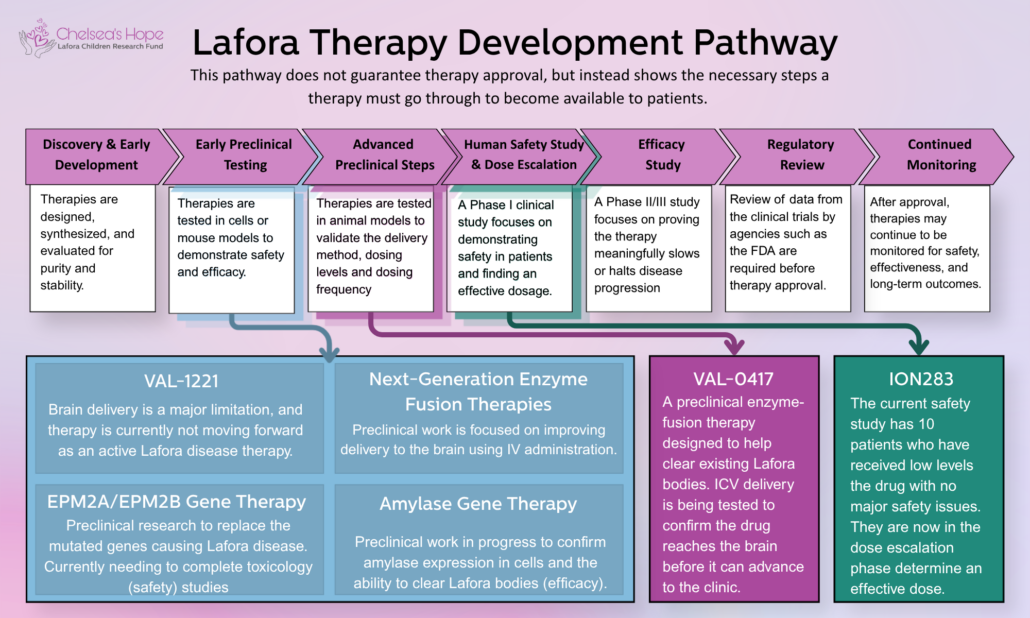
Lafora Therapy Development Pathway This pathway does not guarantee therapy approval, but instead shows the necessary steps a therapy must go through to become available to patients. Discovery & Early Development Early Preclinical Testing Advanced Preclinical Steps Human Safety Study & Dose Escalation Efficacy Study Regulatory Review Continued Monitoring Therapies are designed, synthesized, and evaluated for purity and stability. Therapies are tested in cells or mouse models to demonstrate safety and efficacy. Therapies are tested in animal models to validate the delivery method, dosing levels and dosing frequency A Phase I clinical study focuses on demonstrating safety in patients and finding an effective dosage. A Phase II/Ill study focuses on proving the therapy meaningfully slows or halts disease progression Review of data from the clinical trials by agencies such as the FDA are required before therapy approval. After approval, therapies may continue to be monitored for safety, effectiveness, and long-term outcomes. VAL-1221 Brain delivery is a major limitation, and therapy is currently not moving forward as an active Lafora disease therapy. Next-Generation Enzyme Fusion Therapies Preclinical work is focused on improving delivery to the brain using IV administration. EPM2A/EPM2B Gene Therapy Preclinical research to replace the mutated genes causing Lafora disease. Currently needing to complete toxicology (safety) studies Amylase Gene Therapy Preclinical work in progress to confirm amylase expression in cells and the ability to clear Lafora bodies (efficacy). VAL-0417 A preclinical enzyme-fusion therapy designed to help clear existing Lafora bodies. ICV delivery is being tested to confirm the drug reaches the brain before it can advance to the clinic. ION283 The current safety study has 10 patients who have received low levels the drug with no major safety issues. They are now in the dose escalation phase determine an effective dose.Chelsea's Hope Lafora Children Research Fund 2026

Lafora Therapy Q&A Resources

August 24, 2026/by Chelsea's Hope

Thank you to everyone who joined our recent Lafora Disease Therapy Q&A sessions. We are grateful for the thoughtful questions families submitted and for the continued advocacy, patience, and hope within this community.

During the sessions, we reviewed several new resources created to help explain the current Lafora disease therapy landscape, where different therapies stand in development, and what families can do to stay informed. Keep reading for links to the new therapy pages, resources, and ways to stay connected.

New Therapy Resources

Families can now review the following resources:

Lafora Disease Therapy Overview
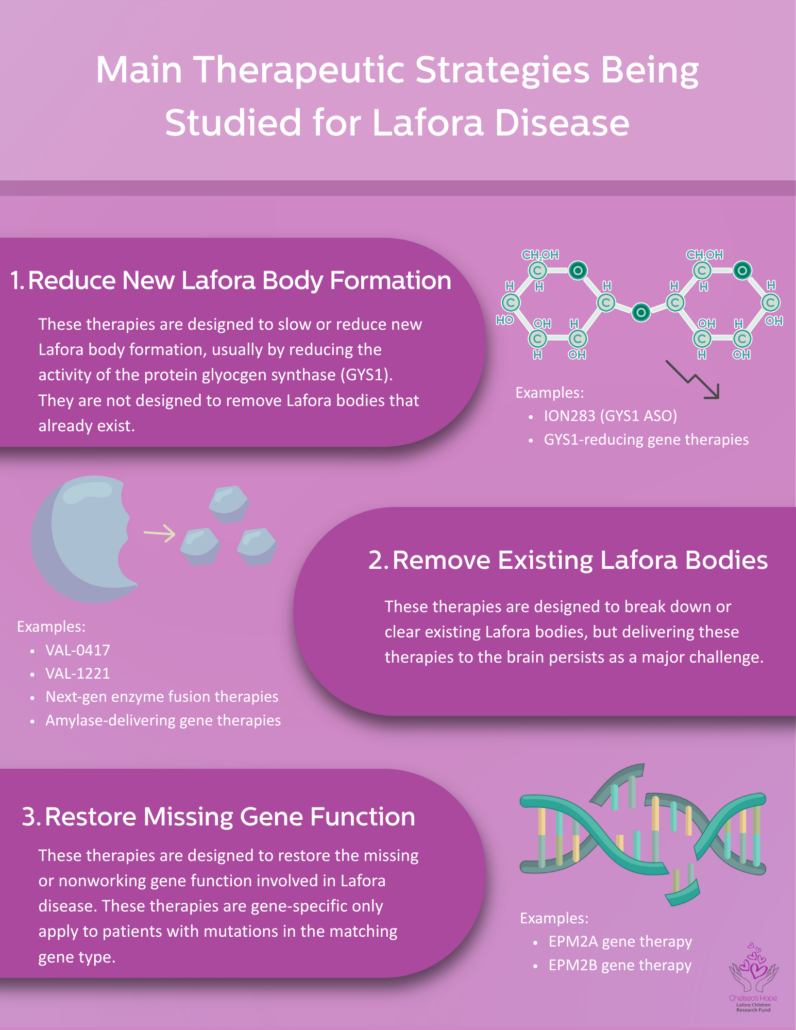
Main Therapeutic Strategies Being Studied for Lafora Disease 1. Reduce New Lafora Body Formation These therapies are designed to slow or reduce new Lafora body formation, usually by reducing the activity of the protein glyocgen synthase (GYS1). They are not designed to remove Lafora bodies that already exist. H HO CHOH O H OH H H OH H CHOH O H OH H H C OH Examples: • ION283 (GYS1 ASO) • GYS1-reducing gene therapies H OH 2. Remove Existing Lafora Bodies These therapies are designed to break down or clear existing Lafora bodies, but delivering these therapies to the brain persists as a major challenge. Examples: • VAL-0417 • VAL-1221 • Next-gen enzyme fusion therapies • Amylase-delivering gene therapies 3. Restore Missing Gene Function These therapies are designed to restore the missing or nonworking gene function involved in Lafora disease. These therapies are gene-specific only apply to patients with mutations in the matching gene type. Examples: • EPMA gene therapy • EPM2B gene therapy Chelsea's Hope Lafora Children Research Fund

This webpage explains the main therapy strategies being studied for Lafora disease, including approaches designed to prevent new Lafora bodies from forming, remove existing Lafora bodies, or restore missing gene function. View the Lafora Disease Therapy Overview webpage here. >

Clinical Pipeline Progress

This webpage explains the steps therapies must move through before reaching patients, including preclinical studies, safety studies, dose escalation, efficacy trials, regulatory review, and continued monitoring. It also includes a current snapshot of where different Lafora therapies stand in the pipeline. View the Clinical Pipeline Progress webpage here. >

ION283 Safety Study Updates

This page will continue to be updated as new information becomes available about the ION283 safety study and next steps. View the ION283 Safety Study webpage. >

Repurposed Drug Resources

We also shared new resources about repurposed drugs. Repurposed drugs are medications originally developed or approved for another condition that are later studied to see whether they may help with Lafora disease.

These resources explain what repurposed drugs are, why they may matter for Lafora disease, and what examples are currently being studied or discussed:

  1. Repurposed Drugs 101
  2. Current Landscape of Repurposed Drugs for Lafora

ION283 Next Steps

During the Q&A, families also heard updates about ION283 and the next steps for moving the program forward.

ION283 remains the furthest along Lafora-specific therapy because it is already in a clinical study. The current focus is dose escalation, which means researchers are working to identify a dose that is safe and has the potential to provide clinical benefit.

Elpida Therapeutics has taken on the ION283 program and is working to move it forward as quickly and responsibly as possible. Important next steps include continued dose escalation as part of the safety study, manufacturing additional drug product, identifying potential phase II trial sites, submitting documentation for regulatory requirements, and planning for a future study that could support broader community access if successful.

At this time, expanded access or compassionate use is not available. More information is still needed about the correct dose, drug supply, trial design, and feedback from regulatory agencies before additional patients can receive ION283.

Chelsea’s Hope will continue sharing updates with families as soon as confirmed information becomes available.

How Families Can Stay Informed


Sign up for emails Sign up for emails

Sign up for emails

The best way to receive future updates about therapy development, clinical trials, family resources, and upcoming events is to sign up for the Chelsea’s Hope newsletter.

We also encourage families to make sure their clinicians are connected with Chelsea’s Hope updates, especially as future clinical trial information becomes available.

Upcoming Events

September Courage in Care: G-Tubes to Manage Lafora Disease
Join us for the next Courage in Care session focused on G-tubes and Lafora disease management. Register for the September Courage in Care here. >

2026 Lafora Disease Science Symposium Dallas, TX 19-21 October2026 Lafora Disease Science Symposium
Families, researchers, clinicians, and advocates will come together to discuss the latest updates in Lafora disease research and care. Register for the 2026 Symposium here. >

Questions?

For general questions, please contact:
katherine@chelseashope.org

For ION283-specific questions, please contact:
ion283@chelseashope.org

For questions related to Elpida Therapeutics and ION283 development, please contact:
Terry@elpidatx.com

Thank you for continuing to stay engaged, ask questions, and advocate for the Lafora disease community. Together, we will keep working toward treatments and a cure!

Share this entry
  • Share on Facebook
  • Share on X
  • Share on WhatsApp
  • Share on Pinterest
  • Share on LinkedIn
  • Share on Tumblr
  • Share on Vk
  • Share on Reddit
  • Share by Mail
https://chelseashope.org/wp-content/uploads/2026/08/Lafora-Therapy-Development-Pathway.png 1200 2000 Chelsea's Hope https://chelseashope.org/wp-content/uploads/2022/02/ChelseasHope1.png Chelsea's Hope2026-08-24 12:07:222026-08-24 12:07:49Lafora Therapy Q&A Resources
You might also like
ION238 Safety Study Update February 2025 Gene Therapy 101
Attendees at the Lafora disease science Symposium 2023 in Bologna Lafora Symposium 2023 in review
ION283 Safety Study Approval ASO Therapy for Lafora Disease ION283 Safety Study Approved
IONIS Statement for the Lafora Community September 4, 2024 Ionis Statement for the Lafora Community
Text says 'ION283 Safety Study ASO Therapy for Lafora Disease' over a background image of the Dallas, Texas, skyline ION283 Safety Study on ClincialTrials.Gov
BECAUSE WE HAVE HOPE Lafora Holiday Season Auction 2024 Announcing Holiday Season Auction
Text says 'ION283 Safety Study ASO Therapy for Lafora Disease' over a background image of the Dallas, Texas, skyline Now Recruiting: ION283 Safety Study
ION238 Safety Study Update February 2025 Safety Study Update – February 2025

About Chelsea’s Hope

Chelsea’s Hope began as a website in the fall of 2007 to share Chelsea Gerber’s story with family and friends. A 501(c)(3) organization since 2009, we have made an impact by raising awareness, connecting families worldwide, funding research, and maintaining hope.

Our mission is to improve the lives of those affected by Lafora disease and help accelerate the development of treatments. [Read More]

View Chelsea’s Hope Newsletter Archive 

Donate to Lafora Research

Latest News

  • Lafora Therapy Q&A Resources

  • Student Ambassador Applications Open

  • Social Security Added Lafora to Compassionate Allowances List

  • Elpida Therapeutics’ Press Release

  • ION283 to be Developed by Elpida Therapeutics

  • Update on the ION283 Program from Telethon

  • Introducing the Lafora Clinical Network Registry

  • Meet our 2026 Summer Interns!

  • Updates for the Lafora Therapy Pipeline: Requesting information from our Research Community

  • Telethon’s Statement on the ION283 Clinical Trial Pathway for Lafora

The mission of Chelsea’s Hope is to improve the lives of those affected by Lafora disease and help accelerate the development of treatments.

Chelsea’s Hope Lafora Children Research Fund is an IRS 501(c)3 nonprofit organization. EIN: 27-1008382

Location imageChelsea’s Hope c/o Dr. Donohue

976 Maywick Dr.

Lexington, KY 40504

info@chelseashope.org

Use ICD-10 code G40.C for Lafora.

    • Follow us on
    • Facebook
    • Instagram
    • Twitter
    • LinkedIn
    • YouTube
    • TikTok
ION283 Safety Study
Copyright © 2017-2026 Chelsea's Hope Lafora Children Research Fund. All Rights Reserved.
  • Home
  • News
  • About Lafora Disease
  • Donate
  • Contact
  • Privacy Policy – Other Policies
Link to: Student Ambassador Applications Open Link to: Student Ambassador Applications Open Student Ambassador Applications OpenChelsea's Hope Student Ambassador Link to: Protected: Pediatric to Adult Care Transition Link to: Protected: Pediatric to Adult Care Transition Courage in Care Lafora Caregiver Series Pediatric to Adult Care Transition Presented by Tuba Rashid Khan, MD, MPH, EdMProtected: Pediatric to Adult Care Transition
Scroll to top Scroll to top Scroll to top