• Link to X
  • Link to Facebook
  • Link to Instagram
  • Link to LinkedIn
  • Link to Youtube
  • Donate to fight Lafora disease!
  • Contact Us
info@chelseashope.org
Chelsea's Hope Lafora Children Research Fund
  • What is Lafora Disease?
    • About Lafora Disease
    • ICD-10 Codes for Lafora Disease
    • Lafora Disease Symptom Checker
    • Lafora Disease Therapy
    • Lafora Disease Clinical Pipeline Progress
    • ION283 Safety Study
    • Family Stories
  • About Us
    • Chelsea’s Story
    • Leadership Team
    • Advisory Board
    • Contact
  • News
  • Resources
    • For Families & Caregivers
      • Newly Diagnosed
      • Tips for Lafora Disease Families
      • Bereavement Support
      • G-Tube Tips – A Mother’s Perspective
      • Lafora Clinical Network Registry
      • Refer Your Clinician to the Registry
    • For Researchers
      • Lafora Mutations Database
      • Lafora Canine Registry and Database
      • Apply to Join the Clinical Registry
  • Events
    • 2026 Lafora Science Symposium
    • Courage in Care: Lafora Caregiver Series
    • Lafora Disease Roundtables
  • Get Involved
    • Ways to Give
    • Volunteer
    • Join Canine Registry
  • Click to open the search input field Click to open the search input field Search
  • Menu Menu
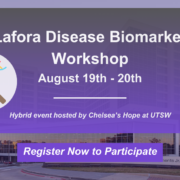
Lafora Disease Biomarker Workshop August 19th - 20th Hybrid event hosted by Chelsea’s Hope at UTSW Register Now to Participate

Announcing the Hybrid Lafora Disease Biomarker Workshop

July 5, 2024/by Kit Donohue

August 19-20, 2024 at UT Southwestern

Chelsea’s Hope is proud to partner with the UT Southwestern Medical Center (UTSW) in Dallas, Texas, to host a biomarker workshop. Our goal is to provide a platform for community education about the role of biomarkers in accelerating the path to clinical trials for Lafora disease. 
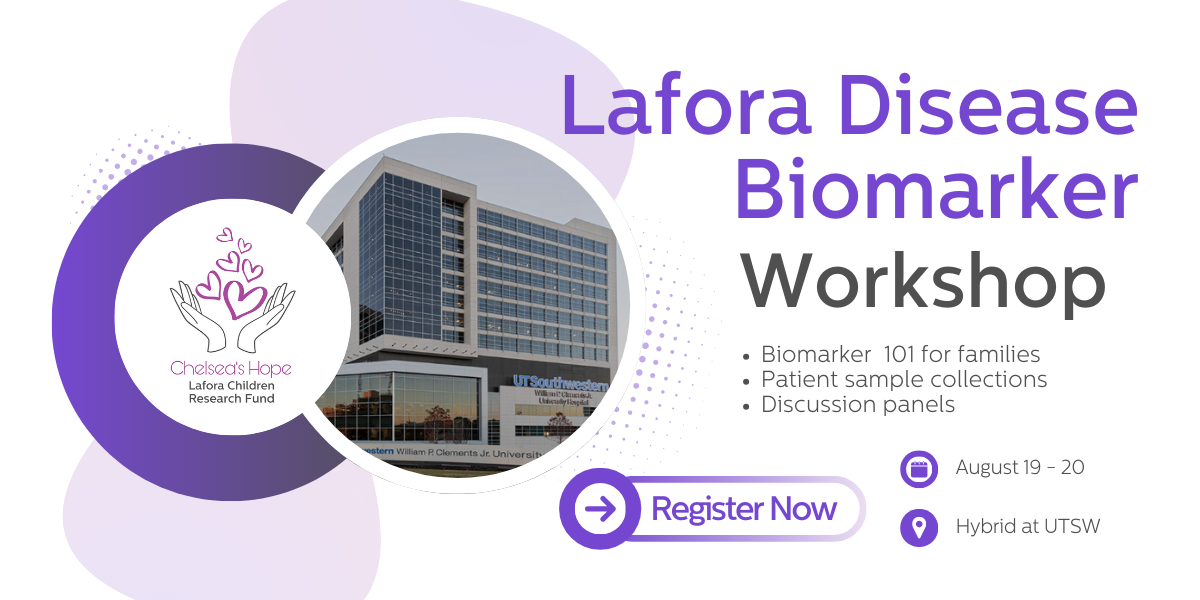
Lafora Disease Biomarker Workshop Biomarker 101 for families Patient sample collections Discussion panels Register Now August 19 - 20 Hybrid at UTSW

For Families

Have you ever wondered why we collect blood serum and CSF samples for our children with Lafora? Do you have questions about why patients undergo regular MRI scans? This workshop is designed to educate about how biomarkers can accelerate the path to therapy approval in clinical trials. Also, we want to learn which biomarkers are the most promising for use in treating Lafora disease. Above all, this knowledge will lead to a brighter future for our children. Please register to attend virtually.

For the Lafora Research Network

Clinicians and researchers, we will be sponsoring several expert discussion panels during the workshop to reach a consensus on protocols for sample collection and critical markers to track. Please register to be a part of the discussion for the topics below: 

  • Metabolic Biomarkers from Serum, CSF, and MRI/FDG-PET scans
  • Epilepsy & EEG Clinical Markers
  • Cognitive Evaluation & Markers
  • Motor Skill Evaluation & Markers


Questions? Please check out our FAQs section on our webpage. 


Register to attend virtually

https://chelseashope.org/wp-content/uploads/2024/07/Biomarkers-workshop-post-featured-image.png 628 1200 Kit Donohue https://chelseashope.org/wp-content/uploads/2022/02/ChelseasHope1.png Kit Donohue2024-07-05 07:50:102024-08-09 14:05:21Announcing the Hybrid Lafora Disease Biomarker Workshop
White text says 'NEW LAFORA DATABASES' above an image of genetic mutation. It has a purple overlay. Purple text over a white block says 'Canine & Mutation.' There is a photo of a beagle to the left of the text. White and purple circles decorate the edges of the graphic, with the round Chelsea's Hope Lafora Children Research Fund logo in the bottom right-hand corner.

Empowering Lafora Disease Research: Launch of Patient Mutation and Canine Databases

May 15, 2024/by Christine Kelly

Hear from Emilie Heller about the launch of two databases she worked on:

“Hi everyone! My name is Emilie and I’ve just wrapped up my time at Chelsea’s Hope as the Research Network Development Intern. I’m excited to share about the launch of two Lafora databases.

Patient Mutation Database

Our new Patient Mutation Database is a comprehensive list of all the reported and published mutations leading to Lafora disease. Firstly, this database will assist with identifying disease-causing mutations. Furthermore, the database will improve our ability to predict mild versus classical disease progression to better treat Lafora patients. The mutation database will be freely available to anyone who registers for access. Researchers and clinicians are also invited to report novel mutations to help us develop a more accurate picture of disease-causing mutations in Lafora disease.

Launch of Canine Registry and Database

During my time interning at Chelsea’s Hope, I also compiled a central database with comprehensive data on affected canines. Numerous canine breeds are susceptible to Lafora disease, a rare and fatal progressive epilepsy causing neurodegeneration. By focusing on canine research on Lafora disease, scientists aim to unravel crucial insights into this complex disorder.

Formed by compiling many studies among leading research institutions, the initiative establishes a dedicated database and registry exclusively focused on collecting canine data related to Lafora disease. This database will serve as a repository for invaluable information, encompassing genetic data, phenotypic profiles, and treatment regimens for affected dogs.

Our organization will maintain and regularly update this database of mutations associated with Lafora disease in canines and their associated phenotypes. By cataloging genetic variations observed in affected canines, researchers will be able to identify patterns and correlations that could shed light on the underlying mechanisms of the disease. This comprehensive canine database is poised to facilitate targeted investigations into the genetic basis of Lafora disease, both paving the way towards finding a cure for our canine friends, and accelerating treatment for human patients with Lafora.”

Researchers and veterinarians can request access to the database. Dog owners can add their affected dog to the Lafora Canine Registry.

Disclaimer: Emilie’s post was edited for clarity.

Find the webpages and forms for accessing the databases on the Chelsea’s Hope website. The organization looks forward to empowering Lafora disease research and fostering collaboration. Finally, please email katherine@chelseashope.org with any questions.

Lafora Mutations Database Page Lafora Canine Registry and Database
https://chelseashope.org/wp-content/uploads/2024/05/Emilie-news-post-featured-image.png 628 1200 Christine Kelly https://chelseashope.org/wp-content/uploads/2022/02/ChelseasHope1.png Christine Kelly2024-05-15 10:54:422024-05-15 10:54:42Empowering Lafora Disease Research: Launch of Patient Mutation and Canine Databases
Research Simplified for families

The Latest Research in Lafora Disease – Summarized for Easy Reading

April 24, 2024/by Maysoon Hussain

Research Simplified for Families

Interested in learning about the new research developments in Lafora disease in a concise and easy-to-read form?

Keep reading for summaries of some of the latest published research in Lafora disease. Our goal is to make the research easier to read and understand for families. You’ll find the research simplified in one-page PDFs, but we will also link to the full peer-reviewed publications.

1. Early Treatment With Metformin Improves Neurological Outcomes in Lafora Disease

  • Metformin treatment was investigated in models of early and late stage Lafora disease, and was found to slow disease progression in both. Read more here. >
  • Read the full peer-reviewed publication. >

2. Effect of Alglucosidase alfa (Myozyme) Therapy in Lafora Disease

  • Myozyme is approved for treatment of Pompe Disease, and researchers investigated if the same treatment would be effective in Lafora disease. However, this study found that Myozyme does not effectively degrade Lafora Bodies. Read more here. >
  • Read the full peer-reviewed publication. >

3. Antisense oligonucleotide (ASO) therapy targeting Gys1 gene

  • ASO therapy has shown promising results in mouse models of Lafora disease, preventing Lafora Body formation and mitigating neuroinflammation. Read more here. > 
  • Read the full peer-reviewed publication. >

4. Identifying CSF and PET scan biomarkers to evaluate progression of Lafora Disease

  • Biomarkers are useful in identifying onset and progression of Lafora disease, as well as determining the efficacy of new treatments. Combining traditional CSF biomarkers with PET scans can improve diagnostic accuracy. Read more here. >
  • Read the full peer-reviewed publication. >

Questions? Contact Maysoon Hussain (maysoonhussain1@chelseashope.org).

See our resources page
https://chelseashope.org/wp-content/uploads/2024/04/Research-Simplified-for-Families.png 628 1200 Maysoon Hussain https://chelseashope.org/wp-content/uploads/2022/02/ChelseasHope1.png Maysoon Hussain2024-04-24 07:58:562024-11-30 07:14:37The Latest Research in Lafora Disease – Summarized for Easy Reading
Chelsea's Hope Lafora Children Research Fund's 2023 ANNUAL REPORT a photo of the report cover page is to the right

Reflecting on Progress: Explore Our Impact in the Chelsea’s Hope 2023 Annual Report

April 2, 2024/by Christine Kelly

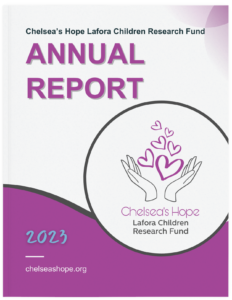
Chelsea's Hope Lafora Children Research Fund's 2023 Annual Report cover pageChelsea’s Hope published its 2023 Annual Report. Inside, you’ll find a letter from our President, a breakdown of our 2023 impact, financials, and what’s next. Our progress is all thanks to the support of our community. Our work is all for our children fighting Lafora Disease.

Since our humble beginnings as a blog started by Chelsea Gerber’s family in 2007, Chelsea’s Hope has remained committed to sharing Lafora stories and connecting families. In 2009, we became a 501c(3) organization to raise funds for research, treatment, and, ultimately, a cure for those affected by Lafora Disease. There are now promising treatments in the pipeline, all thanks to the dedication of the Lafora research network. In 2023, we updated our mission statement to reflect the challenges we seek to overcome.

Our current mission is to improve the lives of those affected by Lafora Disease and help accelerate the development of treatments.

2023 Achievements

Despite its challenges, last year included hopeful advancements. Learn more about our events, programs, and milestones in the 2023 Impact section of the Report.

In 2023, we…

  • Developed a new mission statement.
  • Started the Lafora Disease Research Roundtables.
  • Launched our Volunteer program.
  • Received a 2023 Patient-Partnered Collaborations for Rare Neurodegenerative Disease grant from the Chan Zuckerberg Initiative.
  • Launched a Sibling Support Group program.
  • Welcomed a new secretary to the Board of Directors.
  • Appointed a new Vice President to the Board of Directors.
  • Received a unique ICD-10 Code for Lafora Disease – G40.C – on October 1, 2023. 
  • Supported the 8th Annual Lafora Disease Science Symposium.

Much of our work was possible thanks to the capacity-building grants from the Chan Zuckerberg Initiative. We also received support from the Danny Did Foundation, Vibe Bio, the Every Life Foundation, and generous donations from the Weiss family. We appreciate all our 2023 donors! Your contributions will support our work in 2024.

2024 Goals

However, 2023, like every year before, also left us mourning the passing of more children. We need to stop this.

Our goals for 2024 are to: 

  • Grow and accelerate science objectives that further clinical treatments.
  • Expand and maintain a strong, collaborative, and actionable research network.
  • Strengthen the Chelsea’s Hope organization by hiring dedicated staff.
  • Be an essential source and repository of information for families, clinicians, and researchers.

What’s next? 

  • We will build consensus for standards of care and biomarkers. 
  • Drug Screening for potential repurposing to treat Lafora Disease. 
  • We are expanding the Lafora Disease Patient Registry and launching a Caregiver Registry. 
  • We are hosting the 2024 Lafora Disease Science Symposium and quarterly Research Roundtables. 
  • 2024 Internship Program to make scientific research more accessible to the patient community.


Are you interested in being part of the next chapter of our mission? There are many ways to get involved! One way to stay connected is to sign up for our mailing list, which includes job and board postings and research updates. You can also follow our social media for regular updates. Finally, we always welcome donations and volunteers to support our cause.

We remain committed to reaching a cure for Lafora this year and beyond. Thank you for your partnership!

Read the 2023 Annual Report
https://chelseashope.org/wp-content/uploads/2024/04/Annual-Report-News-Post-Featured-Image.png 628 1200 Christine Kelly https://chelseashope.org/wp-content/uploads/2022/02/ChelseasHope1.png Christine Kelly2024-04-02 09:48:222024-07-30 07:23:45Reflecting on Progress: Explore Our Impact in the Chelsea’s Hope 2023 Annual Report
Page 12 of 37«‹1011121314›»

About Chelsea’s Hope

Chelsea’s Hope began as a website in the fall of 2007 to share Chelsea Gerber’s story with family and friends. A 501(c)(3) organization since 2009, we have made an impact by raising awareness, connecting families worldwide, funding research, and maintaining hope.

Our mission is to improve the lives of those affected by Lafora disease and help accelerate the development of treatments. [Read More]

View Chelsea’s Hope Newsletter Archive 

Donate to Lafora Research

Latest News

  • Press Release: United Against Lafora, Families Worldwide Raise Awareness

  • New Resource: Lafora Anti-Seizure Medication Guidelines

  • Join in Lafora Body Disease Day 2026!

  • Lafora Therapy Q&A Resources

  • Student Ambassador Applications Open

  • Social Security Added Lafora to Compassionate Allowances List

  • Elpida Therapeutics’ Press Release

  • ION283 to be Developed by Elpida Therapeutics

  • Update on the ION283 Program from Telethon

  • Introducing the Lafora Clinical Network Registry

The mission of Chelsea’s Hope is to improve the lives of those affected by Lafora disease and help accelerate the development of treatments.

Chelsea’s Hope Lafora Children Research Fund is an IRS 501(c)3 nonprofit organization. EIN: 27-1008382

Location imageChelsea’s Hope c/o Dr. Donohue

976 Maywick Dr.

Lexington, KY 40504

info@chelseashope.org

Use ICD-10 code G40.C for Lafora.

    • Follow us on
    • Facebook
    • Instagram
    • Twitter
    • LinkedIn
    • YouTube
    • TikTok
ION283 Safety Study
Copyright © 2017-2026 Chelsea's Hope Lafora Children Research Fund. All Rights Reserved.
  • Home
  • News
  • About Lafora Disease
  • Donate
  • Contact
  • Privacy Policy – Other Policies
Scroll to top Scroll to top Scroll to top