• Link to X
  • Link to Facebook
  • Link to Instagram
  • Link to LinkedIn
  • Link to Youtube
  • Donate to fight Lafora disease!
  • Contact Us
info@chelseashope.org
Chelsea's Hope Lafora Children Research Fund
  • What is Lafora Disease?
    • About Lafora Disease
    • ICD-10 Codes for Lafora Disease
    • Lafora Disease Symptom Checker
    • Lafora Disease Therapy
    • Lafora Disease Clinical Pipeline Progress
    • ION283 Safety Study
    • Family Stories
  • About Us
    • Chelsea’s Story
    • Leadership Team
    • Advisory Board
    • Contact
  • News
  • Resources
    • For Families & Caregivers
      • Newly Diagnosed
      • Tips for Lafora Disease Families
      • Bereavement Support
      • G-Tube Tips – A Mother’s Perspective
      • Lafora Clinical Network Registry
      • Refer Your Clinician to the Registry
    • For Researchers
      • Lafora Mutations Database
      • Lafora Canine Registry and Database
      • Apply to Join the Clinical Registry
  • Events
    • 2026 Lafora Science Symposium
    • Courage in Care: Lafora Caregiver Series
    • Lafora Disease Roundtables
  • Get Involved
    • Ways to Give
    • Volunteer
    • Join Canine Registry
  • Click to open the search input field Click to open the search input field Search
  • Menu Menu
Last updated August 2026. L I V I N G W I T H L A F O R A A N T I - S E I Z U R E M E D I C A T I O N G U I D E L I N E S Expert opinion from Lafora Clinical Working Group, Chaired by Dr. Roberto Michelucci. Lafora disease is a rare and progressive form of epilepsy, and families are often told early on that seizure control will require more than one medication and ongoing adjustment over time. This expert opinion summarizes the discussion and survey results from a clinical working group of physicians experienced in treating Lafora disease. It is intended to give families a starting point for discussion with their own healthcare providers. Disclaimer: This article reflects the opinions and survey responses of a clinical working group and is shared for general informational purposes only. It is not medical advice and should not replace guidance from your own healthcare provider. Please review this information with your doctor before making any changes to a treatment plan. ANTI-SEIZURE MEDICATIONS FAVORED FOR LAFORA DISEASE When managing seizures in Lafora disease, clinicians routinely combine multiple anti- seizure medications (ASMs). When selecting which medications to combine for a patient, the clinician considers the efficacy of each drug, as well as the potential side effects. They will also take into account possible drug-drug interactions, the age of the patient, their weight and mental health. Therefore, seizure management may look very different for each patient, which is why it is important to consult with your personal physician. However, the clinical working group determined that the following medications are most commonly used as first-line treatments: Levetiracetam, valproic acid, and perampanel are typically the first medications prescribed for newly diagnosed patients Clonazepam is frequently used in everyday treatment plans, largely for its effect on myoclonus. It is also commonly used as a rescue medication when symptoms worsen Brivaracetam, topiramate, and zonisamide are frequently added to a seizure treatment regimen, often to help reduce myoclonus Phenytoin may be useful for short-term treatment of status epilepticus, but it is not recommended for long-term, chronic use MEDICATIONS GENERALLY AVOIDED IN LAFORA DISEASE Certain Anti-seizure medications, like sodium-channel blockers, are usually avoided because they can worsen myoclonus or fail to control seizures effectively. Some examples include: Carbamazepine Phenytoin (becomes a problem with chronic, ongoing use) Lamotrigine Gabaergic drugs Most anti-focal ASMs PLANNING FOR EMERGENCIES Status epilepticus, prolonged or repeated seizure that doesn't stop on its own, is a medical emergency. Clinicians most commonly reported the use of clonazepam or midazolam as first-line emergency treatment, sometimes followed by levetiracetam, brivaracetam, perampanel, or valproic acid or phenytoin in refractory cases. Every family should have a written seizure action plan in place. This helps ensure that emergency responders and caregivers know what to expect and how to respond, and may help avoid unnecessary ICU admissions. chelseashope.org | info@chelseashope.org | @chelseashopelaforacure | Chelsea’s Hope, 976 Maywick Dr. Lexington, KY 40504Chelsea's Hope Lafora Children Research Fund

New Resource: Lafora Anti-Seizure Medication Guidelines

August 28, 2026/by Chelsea's Hope

Last updated August 2026. L I V I N G W I T H L A F O R A A N T I - S E I Z U R E M E D I C A T I O N G U I D E L I N E S Expert opinion from Lafora Clinical Working Group, Chaired by Dr. Roberto Michelucci. Lafora disease is a rare and progressive form of epilepsy, and families are often told early on that seizure control will require more than one medication and ongoing adjustment over time. This expert opinion summarizes the discussion and survey results from a clinical working group of physicians experienced in treating Lafora disease. It is intended to give families a starting point for discussion with their own healthcare providers. Disclaimer: This article reflects the opinions and survey responses of a clinical working group and is shared for general informational purposes only. It is not medical advice and should not replace guidance from your own healthcare provider. Please review this information with your doctor before making any changes to a treatment plan. ANTI-SEIZURE MEDICATIONS FAVORED FOR LAFORA DISEASE When managing seizures in Lafora disease, clinicians routinely combine multiple anti- seizure medications (ASMs). When selecting which medications to combine for a patient, the clinician considers the efficacy of each drug, as well as the potential side effects. They will also take into account possible drug-drug interactions, the age of the patient, their weight and mental health. Therefore, seizure management may look very different for each patient, which is why it is important to consult with your personal physician. However, the clinical working group determined that the following medications are most commonly used as first-line treatments: Levetiracetam, valproic acid, and perampanel are typically the first medications prescribed for newly diagnosed patients Clonazepam is frequently used in everyday treatment plans, largely for its effect on myoclonus. It is also commonly used as a rescue medication when symptoms worsen Brivaracetam, topiramate, and zonisamide are frequently added to a seizure treatment regimen, often to help reduce myoclonus Phenytoin may be useful for short-term treatment of status epilepticus, but it is not recommended for long-term, chronic use MEDICATIONS GENERALLY AVOIDED IN LAFORA DISEASE Certain Anti-seizure medications, like sodium-channel blockers, are usually avoided because they can worsen myoclonus or fail to control seizures effectively. Some examples include: Carbamazepine Phenytoin (becomes a problem with chronic, ongoing use) Lamotrigine Gabaergic drugs Most anti-focal ASMs PLANNING FOR EMERGENCIES Status epilepticus, prolonged or repeated seizure that doesn't stop on its own, is a medical emergency. Clinicians most commonly reported the use of clonazepam or midazolam as first-line emergency treatment, sometimes followed by levetiracetam, brivaracetam, perampanel, or valproic acid or phenytoin in refractory cases. Every family should have a written seizure action plan in place. This helps ensure that emergency responders and caregivers know what to expect and how to respond, and may help avoid unnecessary ICU admissions. chelseashope.org | info@chelseashope.org | @chelseashopelaforacure | Chelsea’s Hope, 976 Maywick Dr. Lexington, KY 40504We have a new resource for families developed by some members of our Lafora Clinical Network: Anti-Seizure Medication Guidelines. This document provides information to help Lafora families discuss seizure management with their clinicians.

Special thanks to the clinical working group led by Dr. Roberto Michelucci, who put together these guidelines. You can now download the document to your device, or print a copy to reference. Please check back for updates.

View Guidelines Right-open Right-open

Guidelines created in August 2026.


https://chelseashope.org/wp-content/uploads/2026/08/Anti-Seizure-Medication-Guidelines-.png 2000 1414 Chelsea's Hope https://chelseashope.org/wp-content/uploads/2022/02/ChelseasHope1.png Chelsea's Hope2026-08-28 12:11:132026-08-28 12:12:03New Resource: Lafora Anti-Seizure Medication Guidelines

Join in Lafora Body Disease Day 2026!

August 25, 2026/by Chelsea's Hope

It’s that time of year again! We recognize October 1, 2026, as Lafora Body Disease Day.

Chelsea’s Hope will raise awareness to support children fighting for their lives, find answers for families feeling overwhelmed, and accelerate the development of treatments.

We need your participation to make it a success! Creating awareness is key to more research, better support, and a brighter future for families facing Lafora disease. Keep reading for resources and ways to get involved.


Awareness Video

We want to make a “United against Lafora” awareness video, including families, patients, and organizations who can participate from around the world.

If you can join, please email us a short video where you say “United against Lafora” in your language. Include your name and country in the email. Chelsea’s Hope will edit a compilation video and share it publicly on October 1st.

We want as many nationalities and voices represented as possible, but so it doesn’t get too long, we will update this post with those already shared as we receive submissions: Palestine, Slovakia, Bahrain, United States, Poland, Italy, France.

If your nationality is already represented, don’t worry! There are many other ways to join in raising awareness…


Other Ways to Raise Awareness

We invite you to create awareness on October 1 by sharing your story, the stories of the Children of Chelsea’s Hope, educational posts, or encouraging others to watch the Fighting the Rare documentary. 

Families, we encourage you to contact your local news networks to see if they will feature your story. You can email us if you would like support in sharing your story with press outlets.
We invite everyone to join the #FightLafora social media challenge…

#FightLafora Social Media Challenge

One way to raise awareness on Lafora Body Disease Day 2026 is to join the #FightLafora social media challenge. We love seeing how you’ve used the hashtag on your posts and will reshare what we can!

Want to join? Here are the steps:
1. Write “United against Lafora” in your language (this can be holding up a sign, by creating a painting, on the side of your coffee cup…)
2. Take a photo (bonus if you’re wearing purple or your Chelsea’s Hope gear)
3. Share it on your social media
4. Tag us or DM us your photo! Use #FightLafora

+ You can also tag three friends to join the challenge to create awareness about Lafora.


Coffee for Chelsea’s Hope Fundraiser

October 1st is also International Coffee Day, which is why we have a unique fundraiser this year: Coffee for Chelsea’s Hope.

We are asking supporters near and far to donate the amount of your typical drink to advance our mission. Your $5 gift (or $10, we see you, Venti lovers) might not cost you much, but will make a big impact for our cause.

The campaign will run from September 24-October 8, 2026. We will have a special coffee lovers’ giveaway for supporters on October 9, too! 

Finally, you can host your own Coffee for Chelsea’s Hope fundraiser by clicking that “Fundraise” button on our campaign. One idea is bringing coffee into your break room at your office and asking for donations for every cup. Another idea for college students is tabling on your campus. Email us with any questions, and we will be happy to support your fundraiser however we can. Join here!


This annual effort to raise awareness about Lafora is one step toward achieving our mission of improving the lives of those affected by the devastating rare disease and helping to accelerate the development of treatments. Thank you for raising your voice. Together, we can fight Lafora!

https://chelseashope.org/wp-content/uploads/2023/09/English.png 1080 1080 Chelsea's Hope https://chelseashope.org/wp-content/uploads/2022/02/ChelseasHope1.png Chelsea's Hope2026-08-25 13:48:322026-08-31 16:09:15Join in Lafora Body Disease Day 2026!
Lafora Therapy Development Pathway This pathway does not guarantee therapy approval, but instead shows the necessary steps a therapy must go through to become available to patients. Discovery & Early Development Early Preclinical Testing Advanced Preclinical Steps Human Safety Study & Dose Escalation Efficacy Study Regulatory Review Continued Monitoring Therapies are designed, synthesized, and evaluated for purity and stability. Therapies are tested in cells or mouse models to demonstrate safety and efficacy. Therapies are tested in animal models to validate the delivery method, dosing levels and dosing frequency A Phase I clinical study focuses on demonstrating safety in patients and finding an effective dosage. A Phase II/Ill study focuses on proving the therapy meaningfully slows or halts disease progression Review of data from the clinical trials by agencies such as the FDA are required before therapy approval. After approval, therapies may continue to be monitored for safety, effectiveness, and long-term outcomes. VAL-1221 Brain delivery is a major limitation, and therapy is currently not moving forward as an active Lafora disease therapy. Next-Generation Enzyme Fusion Therapies Preclinical work is focused on improving delivery to the brain using IV administration. EPM2A/EPM2B Gene Therapy Preclinical research to replace the mutated genes causing Lafora disease. Currently needing to complete toxicology (safety) studies Amylase Gene Therapy Preclinical work in progress to confirm amylase expression in cells and the ability to clear Lafora bodies (efficacy). VAL-0417 A preclinical enzyme-fusion therapy designed to help clear existing Lafora bodies. ICV delivery is being tested to confirm the drug reaches the brain before it can advance to the clinic. ION283 The current safety study has 10 patients who have received low levels the drug with no major safety issues. They are now in the dose escalation phase determine an effective dose.Chelsea's Hope Lafora Children Research Fund 2026

Lafora Therapy Q&A Resources

August 24, 2026/by Chelsea's Hope

Thank you to everyone who joined our recent Lafora Disease Therapy Q&A sessions. We are grateful for the thoughtful questions families submitted and for the continued advocacy, patience, and hope within this community.

During the sessions, we reviewed several new resources created to help explain the current Lafora disease therapy landscape, where different therapies stand in development, and what families can do to stay informed. Keep reading for links to the new therapy pages, resources, and ways to stay connected.

New Therapy Resources

Families can now review the following resources:

Lafora Disease Therapy Overview
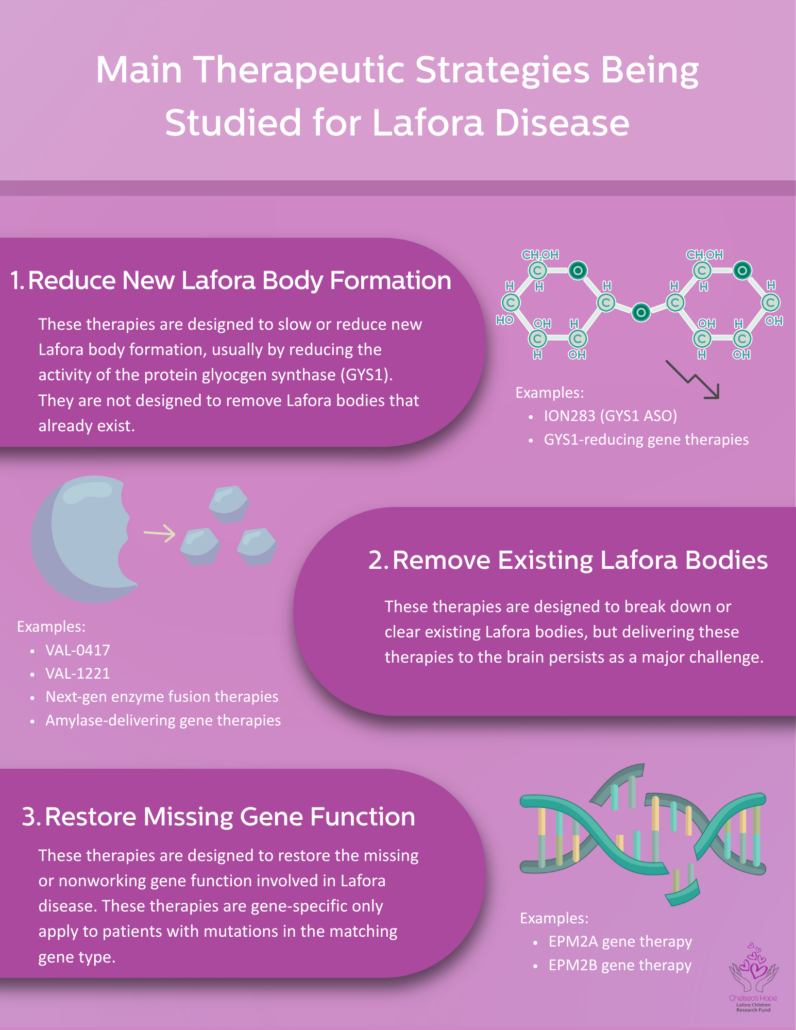
Main Therapeutic Strategies Being Studied for Lafora Disease 1. Reduce New Lafora Body Formation These therapies are designed to slow or reduce new Lafora body formation, usually by reducing the activity of the protein glyocgen synthase (GYS1). They are not designed to remove Lafora bodies that already exist. H HO CHOH O H OH H H OH H CHOH O H OH H H C OH Examples: • ION283 (GYS1 ASO) • GYS1-reducing gene therapies H OH 2. Remove Existing Lafora Bodies These therapies are designed to break down or clear existing Lafora bodies, but delivering these therapies to the brain persists as a major challenge. Examples: • VAL-0417 • VAL-1221 • Next-gen enzyme fusion therapies • Amylase-delivering gene therapies 3. Restore Missing Gene Function These therapies are designed to restore the missing or nonworking gene function involved in Lafora disease. These therapies are gene-specific only apply to patients with mutations in the matching gene type. Examples: • EPMA gene therapy • EPM2B gene therapy Chelsea's Hope Lafora Children Research Fund

This webpage explains the main therapy strategies being studied for Lafora disease, including approaches designed to prevent new Lafora bodies from forming, remove existing Lafora bodies, or restore missing gene function. View the Lafora Disease Therapy Overview webpage here. >

Clinical Pipeline Progress

This webpage explains the steps therapies must move through before reaching patients, including preclinical studies, safety studies, dose escalation, efficacy trials, regulatory review, and continued monitoring. It also includes a current snapshot of where different Lafora therapies stand in the pipeline. View the Clinical Pipeline Progress webpage here. >

ION283 Safety Study Updates

This page will continue to be updated as new information becomes available about the ION283 safety study and next steps. View the ION283 Safety Study webpage. >

Repurposed Drug Resources

We also shared new resources about repurposed drugs. Repurposed drugs are medications originally developed or approved for another condition that are later studied to see whether they may help with Lafora disease.

These resources explain what repurposed drugs are, why they may matter for Lafora disease, and what examples are currently being studied or discussed:

  1. Repurposed Drugs 101
  2. Current Landscape of Repurposed Drugs for Lafora

ION283 Next Steps

During the Q&A, families also heard updates about ION283 and the next steps for moving the program forward.

ION283 remains the furthest along Lafora-specific therapy because it is already in a clinical study. The current focus is dose escalation, which means researchers are working to identify a dose that is safe and has the potential to provide clinical benefit.

Elpida Therapeutics has taken on the ION283 program and is working to move it forward as quickly and responsibly as possible. Important next steps include continued dose escalation as part of the safety study, manufacturing additional drug product, identifying potential phase II trial sites, submitting documentation for regulatory requirements, and planning for a future study that could support broader community access if successful.

At this time, expanded access or compassionate use is not available. More information is still needed about the correct dose, drug supply, trial design, and feedback from regulatory agencies before additional patients can receive ION283.

Chelsea’s Hope will continue sharing updates with families as soon as confirmed information becomes available.

How Families Can Stay Informed


Sign up for emails Sign up for emails

Sign up for emails

The best way to receive future updates about therapy development, clinical trials, family resources, and upcoming events is to sign up for the Chelsea’s Hope newsletter.

We also encourage families to make sure their clinicians are connected with Chelsea’s Hope updates, especially as future clinical trial information becomes available.

Upcoming Events

September Courage in Care: G-Tubes to Manage Lafora Disease
Join us for the next Courage in Care session focused on G-tubes and Lafora disease management. Register for the September Courage in Care here. >

2026 Lafora Disease Science Symposium Dallas, TX 19-21 October2026 Lafora Disease Science Symposium
Families, researchers, clinicians, and advocates will come together to discuss the latest updates in Lafora disease research and care. Register for the 2026 Symposium here. >

Questions?

For general questions, please contact:
katherine@chelseashope.org

For ION283-specific questions, please contact:
ion283@chelseashope.org

For questions related to Elpida Therapeutics and ION283 development, please contact:
Terry@elpidatx.com

Thank you for continuing to stay engaged, ask questions, and advocate for the Lafora disease community. Together, we will keep working toward treatments and a cure!

https://chelseashope.org/wp-content/uploads/2026/08/Lafora-Therapy-Development-Pathway.png 1200 2000 Chelsea's Hope https://chelseashope.org/wp-content/uploads/2022/02/ChelseasHope1.png Chelsea's Hope2026-08-24 12:07:222026-08-24 12:07:49Lafora Therapy Q&A Resources
Chelsea's Hope Student Ambassador

Student Ambassador Applications Open

August 21, 2026/by Chelsea's Hope

Announcing a new program for student volunteers looking to support the Lafora community! If you are a current university student in the United States, consider applying for our Student Ambassador Program this fall. Student Ambassadors will be trained to host events on their campus to raise awareness and funding for Lafora disease research. Applications for the fall semester are open from now until 11:59 PM EDT on Tuesday, September 8th. Read more below about the initiative.

Apply Here


Student Ambassador Program Overview

The Student Ambassador program is a semester-long volunteer initiative that will be self-paced with guidance from our Scientific and Executive Director. Student Ambassadors will be responsible for developing an awareness and fundraising campaign at their university to support Lafora disease research and are expected to attend monthly group meetings. The student ambassador will become a liaison on their campus for the work being done at Chelsea’s Hope. Student ambassadors should expect to work an average of 10 hours per month on the project and set a fundraising goal of $250. The length of the program is one semester starting in September. Download the position description here.

Email katherine@chelseashope.org with questions.

https://chelseashope.org/wp-content/uploads/2026/08/Student-Ambassador-2026-.png 628 1200 Chelsea's Hope https://chelseashope.org/wp-content/uploads/2022/02/ChelseasHope1.png Chelsea's Hope2026-08-21 15:00:262026-09-03 13:21:29Student Ambassador Applications Open
Page 1 of 37123›»

About Chelsea’s Hope

Chelsea’s Hope began as a website in the fall of 2007 to share Chelsea Gerber’s story with family and friends. A 501(c)(3) organization since 2009, we have made an impact by raising awareness, connecting families worldwide, funding research, and maintaining hope.

Our mission is to improve the lives of those affected by Lafora disease and help accelerate the development of treatments. [Read More]

View Chelsea’s Hope Newsletter Archive 

Donate to Lafora Research

Latest News

  • New Resource: Lafora Anti-Seizure Medication Guidelines

  • Join in Lafora Body Disease Day 2026!

  • Lafora Therapy Q&A Resources

  • Student Ambassador Applications Open

  • Social Security Added Lafora to Compassionate Allowances List

  • Elpida Therapeutics’ Press Release

  • ION283 to be Developed by Elpida Therapeutics

  • Update on the ION283 Program from Telethon

  • Introducing the Lafora Clinical Network Registry

  • Meet our 2026 Summer Interns!

The mission of Chelsea’s Hope is to improve the lives of those affected by Lafora disease and help accelerate the development of treatments.

Chelsea’s Hope Lafora Children Research Fund is an IRS 501(c)3 nonprofit organization. EIN: 27-1008382

Location imageChelsea’s Hope c/o Dr. Donohue

976 Maywick Dr.

Lexington, KY 40504

info@chelseashope.org

Use ICD-10 code G40.C for Lafora.

    • Follow us on
    • Facebook
    • Instagram
    • Twitter
    • LinkedIn
    • YouTube
    • TikTok
ION283 Safety Study
Copyright © 2017-2026 Chelsea's Hope Lafora Children Research Fund. All Rights Reserved.
  • Home
  • News
  • About Lafora Disease
  • Donate
  • Contact
  • Privacy Policy – Other Policies
Scroll to top Scroll to top Scroll to top