
Tag Archive for: lafora treatment

ION283 Safety Study Approved

We just learned from Dr. Minassian that the FDA has approved the ION283 Safety Study!

We are so grateful for your continuous support, for Dr. Minassian and his team at UTSW, Dr. Messahel, IONIS, and everyone involved for getting us here.

Our patient community has been a driving force in supporting reaching this stage and we can celebrate another step forward today. We hope this will lead to treatments for our children.

Berge A. Minassian, M.D

“30 years in the making, we now have FDA approval to start our ION283 clinical trial.

I would like to thank each of your associations for your support over the years…” – Dr. Berge Minassian

We do not yet have the application site on clinicaltrials.gov or the criteria for inclusion in the Safety Study. Those will be coming in a few weeks. In the meantime, we can continue fundraising and ensuring all patient families learn of this opportunity.

Budget

The estimated cost of the Safety Study is $1.5 million USD. Please remember, donations do not guarantee a spot for your loved one in the trial. We encourage donations through a patient organization. Chelsea’s Hope has an online fundraiser where you can donate and we will transfer the money to UTSW.

France Lafora is also fundraising HERE.


Please help us share this information! 

If you did not get an email update from us earlier, please ensure you are signed up for our mailing list. Once we learn the criteria from Dr. Minassian, we will send out the information to everyone who has signed up for “research updates.” You can contact christine@chelseashope.org to confirm your email preferences with the subject “Check my Chelsea’s Hope Email Preferences.”

Questions? Please check out our FAQs section on our webpage. 

We answer commonly asked questions about the safety study, including what it is, how much it costs, who can participate, and more! If you don’t see an answer to your question, please email katherine@chelseashope.org with the subject “Safety Study Question.”
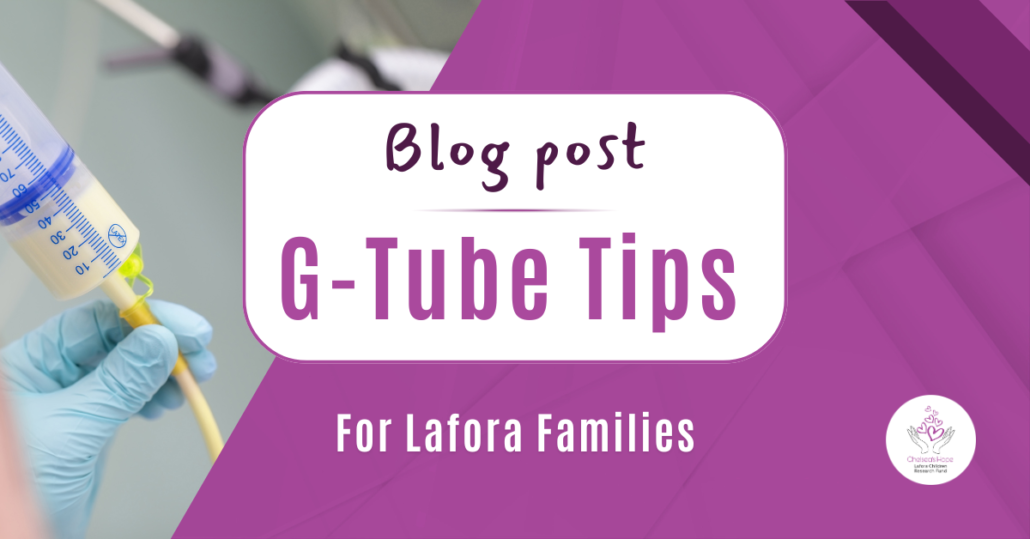
G-Tube Tips – A Mother’s Perspective

G-Tube Tips for Lafora Disease Patients blog

A Mother’s Perspective on the Benefits of a Feeding Tube for Lafora Disease Patients

Has your child got a Gastrostomy tube, or have you been advised they will need it?

It is a very daunting decision to make as you are still grieving from the devastating diagnosis and watching your child change so rapidly. Take the time to research gastronomy tubes (g-tube) and decide when you feel ready. It is another big change for you, the family, and especially your child. Here are a few recommendations I’d like to share to help make this decision and to make it easier if and where possible.

The benefits of getting a gastrostomy tube inserted early can be helpful as your child is less at risk when their Lafora symptoms are less severe. Having the g-tube early will save on trips to the hospital if there are emergencies where you need to administer emergency medications. You can save the stress by helping your child in the comfort of your own home. You can also give additional nutrition if they are not adequately meeting their dietary requirements. A g-tube will help keep them strong for a lot longer, especially if you can provide them with nutrition that they necessarily wouldn’t eat if you asked them to.

Tips for caring for your child with a gastrostomy tube:

  1. A low-fiber formula for nutrition is ideal, as a formula with high fiber is hard for a slow gut to process. A high-fiber formula could cause more frequent constipation and vomiting issues as their bodies cannot break down the fiber quickly enough. A high protein feed with a good water intake is helpful. 
  2. Stool softeners can alleviate any adverse effects, like constipation and vomiting.
  3. If lying down, elevate their head to a 30–45-degree elevation to avoid aspiration into their lungs.
  4. If you can administer the formula slowly or intermittently, then this will help them absorb it and avoid overfill, which can cause vomiting. 
  5. Overnight feeds can help if they get upset with having to be fed this way and put less stress on the body to work quickly. 
  6. Venting/Degassing is good if they are having painful gas issues.

More information on g-tubes 

Our Resources page has links to helpful tips. More information on ways to care for your child with a gastrostomy tube can also be found here. You can also join the TubeFed community on Facebook. Finally, check out these resources I’ve found helpful. 

My recommendations are from my own experience with my daughter and shared from a mother’s/carer’s point of view. Please discuss everything with your healthcare team and follow any medical practitioner’s advice when given.

Sending Love

Niki

Parent and Director of Family Support