Lafora Disease Clinical Pipeline Progress

Understanding Therapy Development

Developing a Lafora disease therapy takes many steps. A therapy may show promise in a lab or animal model, but researchers still need to understand whether it is safe, whether it reaches the brain, what dose is needed, and whether it can meaningfully help patients.

This page explains the major stages of therapy development and where current Lafora-focused therapies are in the pipeline.

This information is for education only and should not replace medical advice from a physician or care team.
ON THIS PAGE

Clinical Trial Readiness

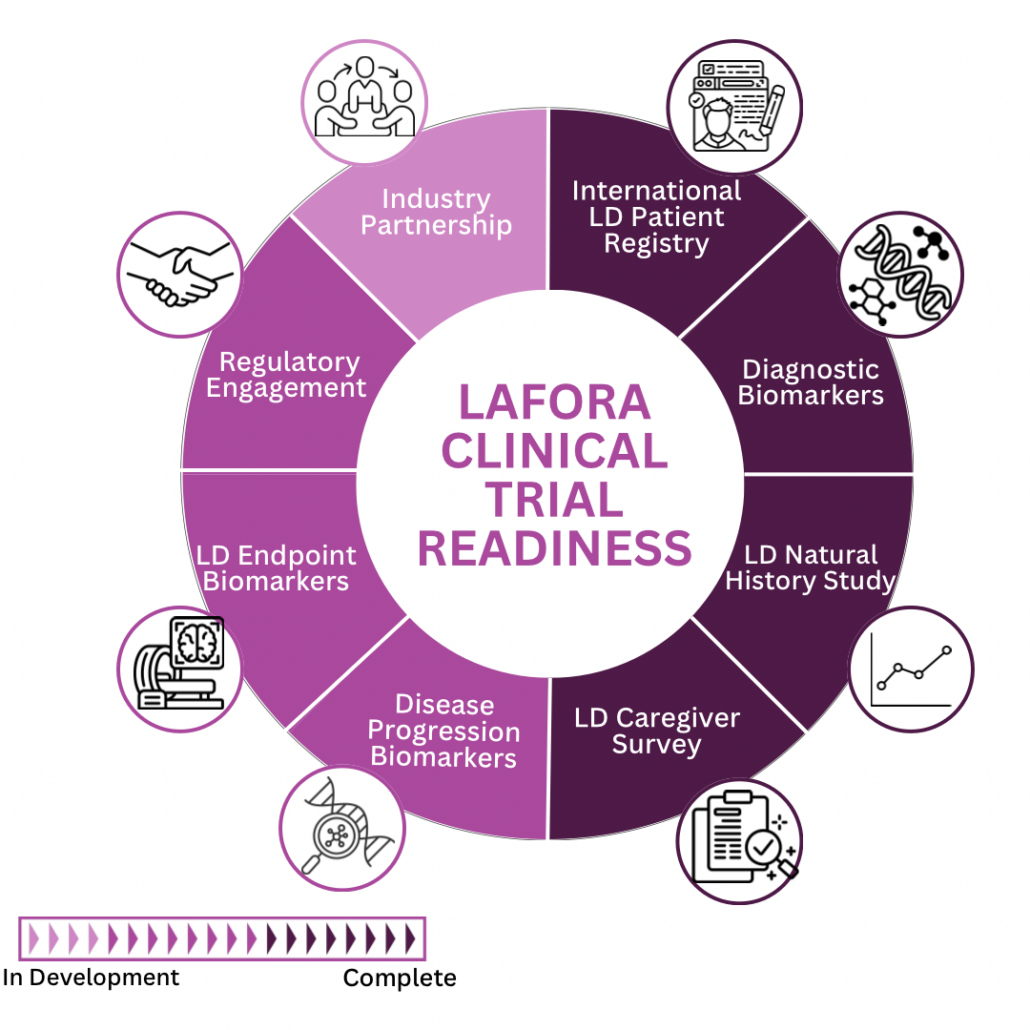
This graphic shows key areas that support Lafora disease (LD) clinical trial readiness. These areas do not happen in one strict order; instead, they often move forward at the same time and together help strengthen the path toward future clinical trials.

                                                         Lafora Clinical Trial Readiness Chart showing In development: industry partnership; in progress: regulatory engagement, LD endpoint biomarkers, disease progression biomarkers; complete: LD caregiver survey, LD natural history study, diagnostic biomarkers, international LD patient registry

Please refer to the clinical trial readiness key terms document for brief explanations of each clinical trial readiness area.

Therapy Pipeline Stages

1

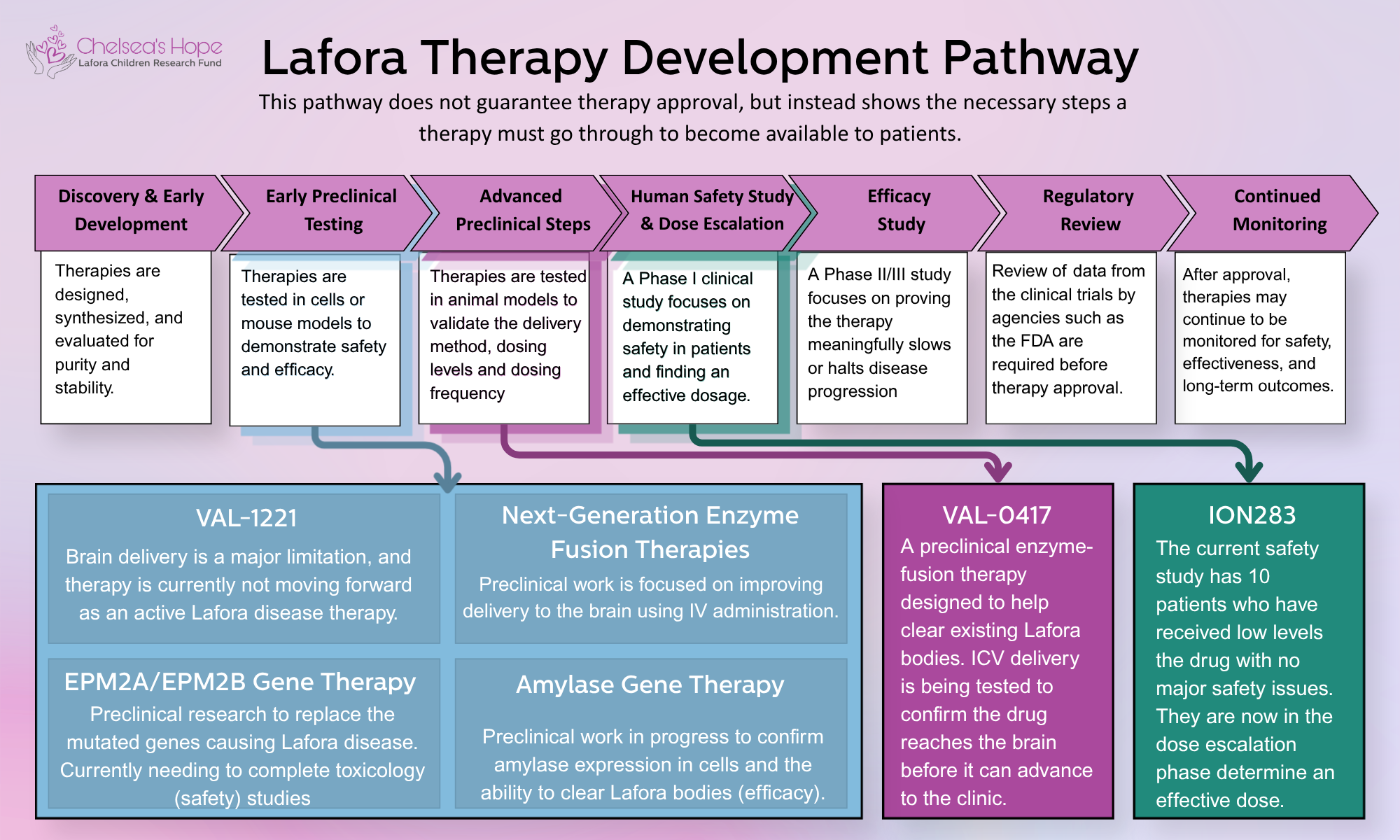
Discovery and Early Development

Therapies in this stage are still being designed, selected, or tested in early models. Researchers may be identifying a target, designing a drug, or deciding which candidate is strongest.

Examples may include:

  • Early enzyme fusion candidates
  • Exploratory gene therapy combinations
  • Early delivery strategies

These therapies may be scientifically interesting, but they are not close to patient use yet.

2

Preclinical Studies

Preclinical studies test therapies in cells, mice, or larger animal models. These studies help researchers understand whether a therapy reaches the right tissue, works in the right cells, and appears safe enough to move forward.

Examples include:

  • VAL-0417
  • Next-generation enzyme fusion therapies
  • EPM2A gene therapy
  • EPM2B gene therapy
  • GYS1-targeted gene therapy approaches

Major questions in this stage include:

  • Does the therapy reach the brain?
  • Does it enter the correct cells?
  • Does it reach the right part of the cell?
  • What dose is needed?
  • What is the maximum tolerated dose?
  • Are there toxicology concerns?
  • How long does the effect last?
3

Human Safety Study

A human safety study is an early clinical trial designed mainly to test whether a therapy can be given safely to people.

Example:

  • ION283

ION283 is currently the main Lafora-focused therapy discussed as being in the clinic. The current challenge is dose escalation: researchers need to move from a low starting dose toward a dose more likely to show clinical effect, while still meeting safety and regulatory requirements.

4

Efficacy Studies

Efficacy studies test whether a therapy benefits patients. These studies usually come after earlier safety testing.

For Lafora disease, possible outcomes may include:

  • Slowing loss of walking or mobility
  • Slowing worsening on clinical performance scales
  • Reducing seizure burden
  • Slowing cognitive decline
  • Reducing or preventing further disease progression
  • Identifying biomarkers that show whether the therapy is affecting the disease pathway
5

Regulatory Review and Approval

If a therapy shows enough safety and effectiveness, researchers or companies can apply for regulatory approval. This step requires strong data and communication with agencies such as the FDA or EMA.

6

Continued Monitoring

Even after approval, therapies may continue to be monitored for safety, effectiveness, and long-term outcomes.

Current Therapy Pipeline Snapshot

Therapy Current Position in Pipeline What Still Needs to Happen
ION283 / GYS1 ASO Human safety study / dose escalation Higher dose testing, continued safety monitoring, and later efficacy studies
VAL-0417 Preclinical development Delivery testing, dosing studies, toxicology studies, and development pathway planning
VAL-1221 Previously reached clinical testing in Pompe disease; paused or limited for Lafora disease because of brain delivery challenges A way to reach the brain would be needed before it could move forward for Lafora disease
Next-generation enzyme fusion therapies Preclinical candidate development Candidate selection, dose testing, toxicology, and animal studies
EPM2A gene therapy Preclinical Ensure therapy reaches all cells in the brain; dose-finding, toxicology, clinical-grade vector testing, and delivery planning
EPM2B gene therapy Preclinical Ensure therapy reaches all cells in the brain; dose-finding, toxicology, and vector testing

ION283 Clinical Progress

ION283 is the Lafora-focused therapy currently furthest along in the clinical pipeline. It is in a human safety study and is moving through dose escalation.

Because early safety studies begin cautiously, the starting dose was low. The goal of dose escalation is to move toward a dose that remains safe but is more likely to show clinical benefit.

Our ION283 webpage can provide more detailed and regularly updated information, such as study updates, dose escalation updates, enrollment progress, next regulatory steps, and frequently asked questions. View more here. >

Treatment Timing and Expected Outcomes

Treatment timing may affect what a therapy can realistically do. Earlier treatment may have a greater chance of preventing or slowing symptoms, while later treatment may focus more on slowing further progression rather than reversing symptoms.

Pre-symptomatic or Very Early Diagnosis

For patients diagnosed before symptoms begin, the treatment goal may be to prevent disease onset, prevent seizures from developing, or slow Lafora body accumulation before symptoms begin.

Early-Stage Disease

For patients in the early stage of disease, the treatment goal may be to slow or halt progression while symptoms are still more manageable.

Mid- to Late-Stage Disease

For patients who are already further along in disease progression, the treatment goal may be to slow further progression, reduce additional decline, and continue managing seizures and symptoms with medical care.

Summary for Families

Lafora disease therapies are moving through the development process at different speeds. ION283 is currently the most clinically advanced Lafora-focused therapy, while several enzyme therapy and gene therapy approaches remain preclinical.

Moving a therapy forward takes time because researchers need to understand safety, dosing, delivery to the brain, clinical benefit, and regulatory requirements. Clinical trial readiness also depends on registries, biomarkers, natural history studies, caregiver input, regulatory engagement, and partnerships.

Although many therapies are not yet available to patients, progress is being made across several areas of research. The goal of this page is to help families understand where each therapy stands and what steps still need to happen.